For decades, the construction industry has operated the same way: assemble materials on-site, battle weather delays, manage multiple subcontractors, and hope the project finishes close to schedule. Modular construction flips this model — moving 80% of building work into a controlled factory environment. But does it actually deliver better results? We analyzed data from completed projects to find out.
The Core Difference: Factory vs. Field
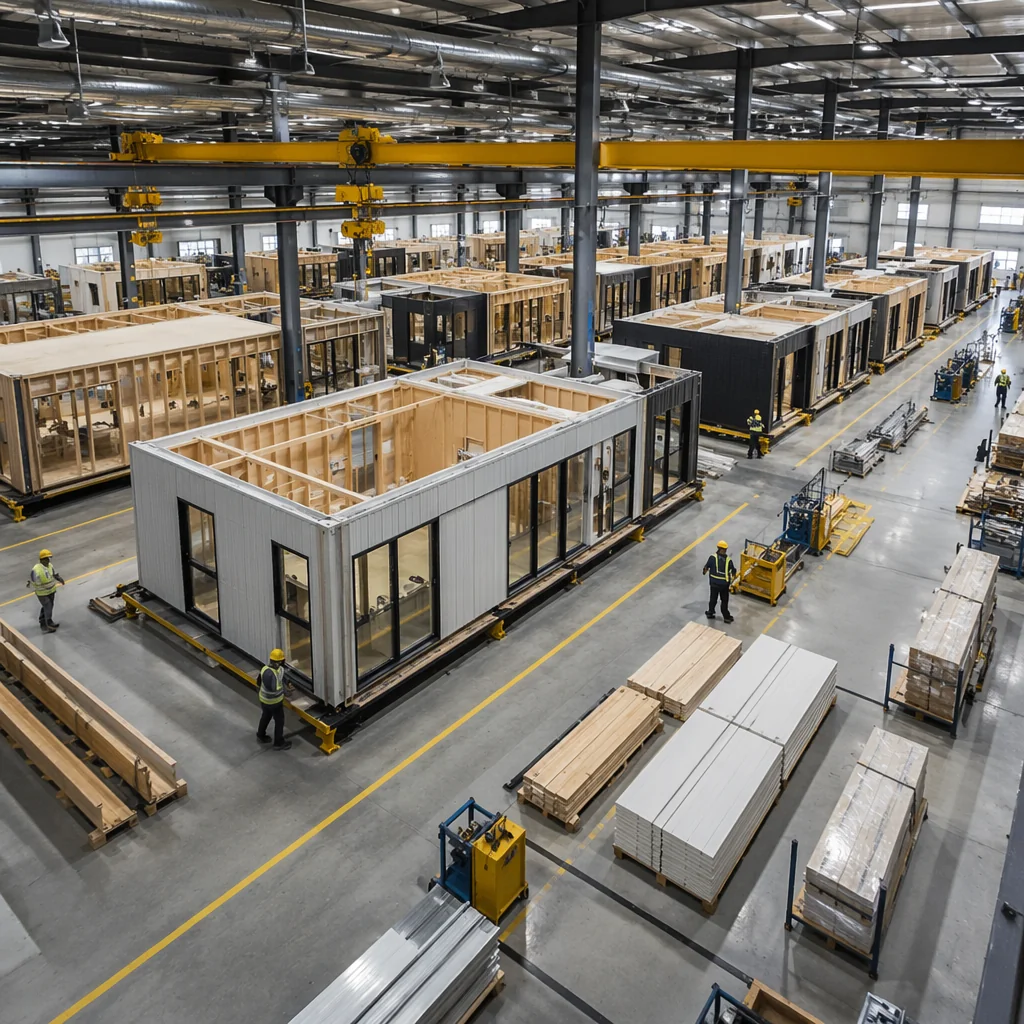
Traditional construction is a craft process — materials are cut, assembled, and finished on-site by crews working in open weather. Modular construction is a manufacturing process — buildings are produced in assembly-line factories with precision tooling, quality stations, and climate control. This fundamental difference ripples through every metric that matters to developers.
Timeline: 50% Faster, Consistently
Our data shows that modular projects complete in approximately half the time of comparable traditional builds. A 100-unit apartment building that takes 16-18 months conventionally finishes in 7-9 months modular. The speed advantage comes from parallel workflows: while the factory builds modules, the site crew prepares foundations and utilities simultaneously.
On a recent 150-key hotel project in Texas, the developer saved 11 months compared to their original conventional timeline. That translated to roughly $2.3M in additional revenue from opening before peak season.
Typical Timeline Comparison (100-Unit Apartment Building)
- Traditional: 16–18 months (design 4 mo + site prep 2 mo + construction 10-12 mo)
- Modular: 7–9 months (design 3 mo + parallel factory + site prep 5-6 mo)
- Time saved: 8–10 months (47–55% reduction)
Cost: 15-20% Lower Total Project Cost
Modular construction's cost advantage isn't just in labor savings — though factory labor is significantly more efficient than on-site labor. The real savings come from three compounding factors:
- Reduced labor costs: Factory workers are 40% more productive than on-site crews, thanks to repetition, tooling, and weather-free environment.
- Shorter financing period: A 9-month project accrues less interest than an 18-month project. On a $20M development, that's $500K-$800K in interest savings alone. For a complete breakdown of how compressed timelines improve project economics, read our modular construction financing guide.
- Predictable budgeting: Factory production eliminates weather delays, material shortages, and subcontractor scheduling conflicts. 92% of our projects deliver within 5% of the original budget.
Cost Breakdown Comparison (100-Unit, Mid-Market Apartments)
- Traditional: $18.5M – $22M (wide variance, 15-20% change orders common)
- Modular: $15.5M – $17.5M (narrow variance, <5% change orders)
- Total savings: $2.5M – $4.5M (15–20% reduction)
Quality: Precision You Can Measure
On a traditional construction site, dimensional tolerances of ±25mm are considered acceptable. In our factory, modules are built to ±2mm — the kind of precision you expect in aerospace, not construction. Every workstation has digital checklists, and every module is inspected before it leaves the factory.
This precision translates directly to fewer defects. Our post-occupancy data shows:
- 73% fewer punch-list items than traditional projects
- 60% reduction in warranty claims in the first year
- STC 55 acoustic performance (exceeds IBC requirement by 5 points)
Environmental Impact: The Greenest Way to Build
Construction accounts for 39% of global carbon emissions. Modular construction doesn't just marginally improve this — it fundamentally restructures how buildings are made:
- 70% less waste: Factory cut-offs are recycled; on-site waste is nearly zero
- 30% lower embodied carbon: Efficient material use + reduced transport trips
- 25% above energy code: Tighter envelopes, better insulation, fewer thermal bridges. For a complete picture of how modular construction reduces embodied carbon and achieves green certifications, read our guide to sustainable modular construction.
- Designed for disassembly: Modules can be relocated, not demolished
When Modular Makes Sense (and When It Doesn't)
Modular construction isn't the right answer for every project. Based on our experience, here's where it excels and where traditional construction may still be preferable:
Modular excels when:
- Project has repeating unit types (apartments, hotel rooms, dormitories). See our developer's guide to modular apartments for a detailed project example.
- Speed-to-market is critical (hospitality, student housing)
- Budget certainty is a priority (affordable housing, government projects)
- Site is in dense urban area (less on-site disruption, shorter crane time)
Traditional may be better when:
- Building has highly custom, non-repeating geometry
- Site access cannot accommodate truck delivery of modules
- Project is a single-family custom home with unique design
- Local building codes explicitly prohibit modular (increasingly rare)
The Bottom Line
For the majority of multi-family residential, hospitality, and commercial projects, modular construction delivers measurable improvements across every metric: faster, cheaper, higher quality, and more sustainable. As factory technology and BIM integration continue to advance, the gap will only widen.
The question for developers in 2026 isn't whether modular is viable — completed projects and 18 countries have answered that. The question is whether you can afford to keep building the slow way. For a detailed breakdown of per-square-foot costs across building types, see our complete guide to modular construction costs.
Want to see if modular works for your next project? Contact our team for a free feasibility assessment and detailed cost-timeline comparison.