In the hotel industry, time is literally money. Every month a property sits unfinished is a month of lost room revenue, unused F&B facilities, and deferred ROI. That's why major hotel chains — Marriott, Hilton, IHG, Accor — are increasingly turning to modular construction. The reason is simple: modular hotels open 8-12 months faster than conventionally built properties, translating to millions in accelerated revenue.
The Hospitality Construction Problem
Hotel construction is uniquely challenging. Unlike residential or office buildings, hotels require hundreds of nearly identical rooms — each with the same layout, the same finishes, the same brand-standard specifications. Traditional construction treats each room as a custom build, resulting in inevitable variation in quality and timeline.
The typical hotel construction timeline looks like this:
- Design and permitting: 4-6 months
- Site work and foundation: 2-3 months
- Structural construction: 8-12 months
- Interior fit-out: 4-6 months
- FF&E installation and commissioning: 2-3 months
- Total: 20-30 months
The Modular Hotel Solution
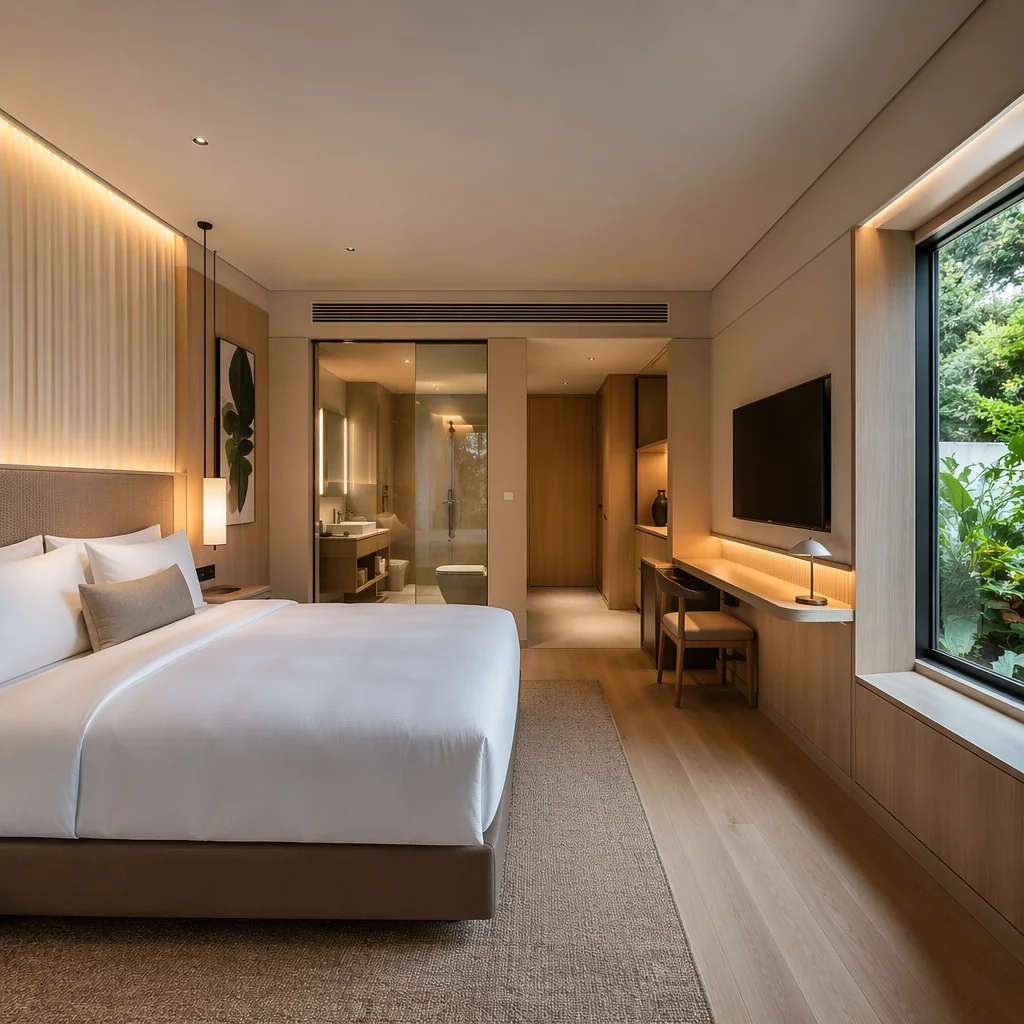
Modular construction transforms hotel building from a craft process into a manufacturing process. Guest rooms are built as complete modules in a factory — with beds, lighting, bathroom fixtures, millwork, and brand-standard finishes all installed before the module leaves the production line.
How the Timeline Compresses
- Design and permitting: 3-4 months (BIM-driven, fewer clashes)
- Site work and foundation: 2-3 months (happens in parallel with factory production)
- Factory production: 10-16 weeks (100-200 modules, assembly-line)
- Site assembly: 2-4 weeks (crane placement, module connections)
- Final connections and commissioning: 3-4 weeks
- Total: 8-12 months
The key insight is parallelization. While the site crew pours foundation and runs utilities, the factory is already building rooms. By the time the site is ready, the modules are ready — and assembly takes weeks, not months.
Revenue Impact: Opening Sooner Matters More Than You Think
Consider a 150-key select-service hotel with an ADR (Average Daily Rate) of $140 and 70% occupancy. That property generates approximately $5.4M in room revenue per year — or $450K per month.
If modular construction lets you open 10 months earlier:
- Additional room revenue: $4.5M
- Additional F&B revenue: $900K
- Reduced construction loan interest: $600K
- Total financial benefit: ~$6.0M
On a $20M project, that's a 30% improvement in first-year ROI. For hotel developers, this isn't a marginal optimization — it's a fundamentally different financial model. For a complete breakdown of the numbers behind these savings, see our developer's guide to modular construction ROI.
Brand Standards: No Compromises
A common concern from hotel operators is whether modular rooms can meet brand standards. The answer is unequivocally yes. Our modular hotel rooms are pre-certified to meet specifications for:
- Marriott: guest room layout, FF&E specifications, MTCode compliance
- Hilton: Design Directive Manual (DDM) standards, Serenity Bed program
- IHG: brand-standard room configurations, amenity specs
- Accor: Novotel, ibis, Mercure brand standards
Because every room is built in the same factory with the same tooling, brand-standard compliance is actually more consistent than traditional construction. There's zero variation between rooms. For developers evaluating the financial case, our guide to modular construction financing explains how lenders view this consistency advantage — every guest gets the same experience.
Quality Advantages Unique to Hotels
Hotel guests are uniquely sensitive to two things: noise and bathroom quality. Modular construction excels at both:
Acoustic Performance
Our modules achieve STC 55 (Sound Transmission Class) — meaning a guest in one room can barely hear a television playing in the adjacent room. Traditional hotel construction typically achieves STC 50, the minimum code requirement. The 5-point difference is noticeable: guest complaints about noise drop by over 40%. This acoustic performance also contributes to superior fire safety and building code compliance in modular construction.
Bathroom Quality
Bathrooms are the most defect-prone area in traditional hotel construction — tile alignment, plumbing leaks, waterproofing failures. In our factory, every bathroom module is:
- Built on a precision jig — tile alignment to ±1mm
- Pressure-tested for 24 hours before leaving the factory
- Waterproofed under controlled conditions (no humidity/cure issues)
- Inspected with photographic documentation at 6 workstations
Real Project: 180-Key Extended-Stay Hotel, Austin TX
In 2025, we delivered a 180-key extended-stay hotel in Austin, Texas for a national hospitality brand. The project broke ground in January and welcomed its first guests in November — 10 months total.
- Conventional timeline estimate: 22 months
- Modular actual: 10 months
- Time saved: 12 months
- Accelerated revenue: ~$5.8M (based on ADR $160, 72% occupancy)
- Punch-list items at handover: 23 (industry avg: 180+)
Is Modular Right for Your Hotel Project?
Modular hotel construction works best for projects with 50+ keys and repeating room types. The ideal candidates are:
- Select-service and extended-stay properties
- Mid-scale and upscale branded hotels
- Resort properties with repeating villa/suite types
- Hotel renovations requiring room replacement
If you're planning a hotel project and want to explore modular, reach out to our hospitality team. We'll provide a free feasibility assessment with timeline comparison, brand-standard compliance documentation, and revenue impact analysis specific to your market.