The construction industry has a sustainability problem. Buildings account for 39% of global carbon emissions — 11% from operational energy and 28% from embodied carbon in materials and construction processes. Traditional construction is inherently wasteful: material off-cuts pile up in dumpsters, weather ruins exposed materials, and over-ordering is standard practice to avoid shortages.
Modular construction doesn't just incrementally improve this — it restructures the entire building process around efficiency. The result: 70% less waste, 30% lower embodied carbon, and buildings designed for eventual disassembly and reuse.
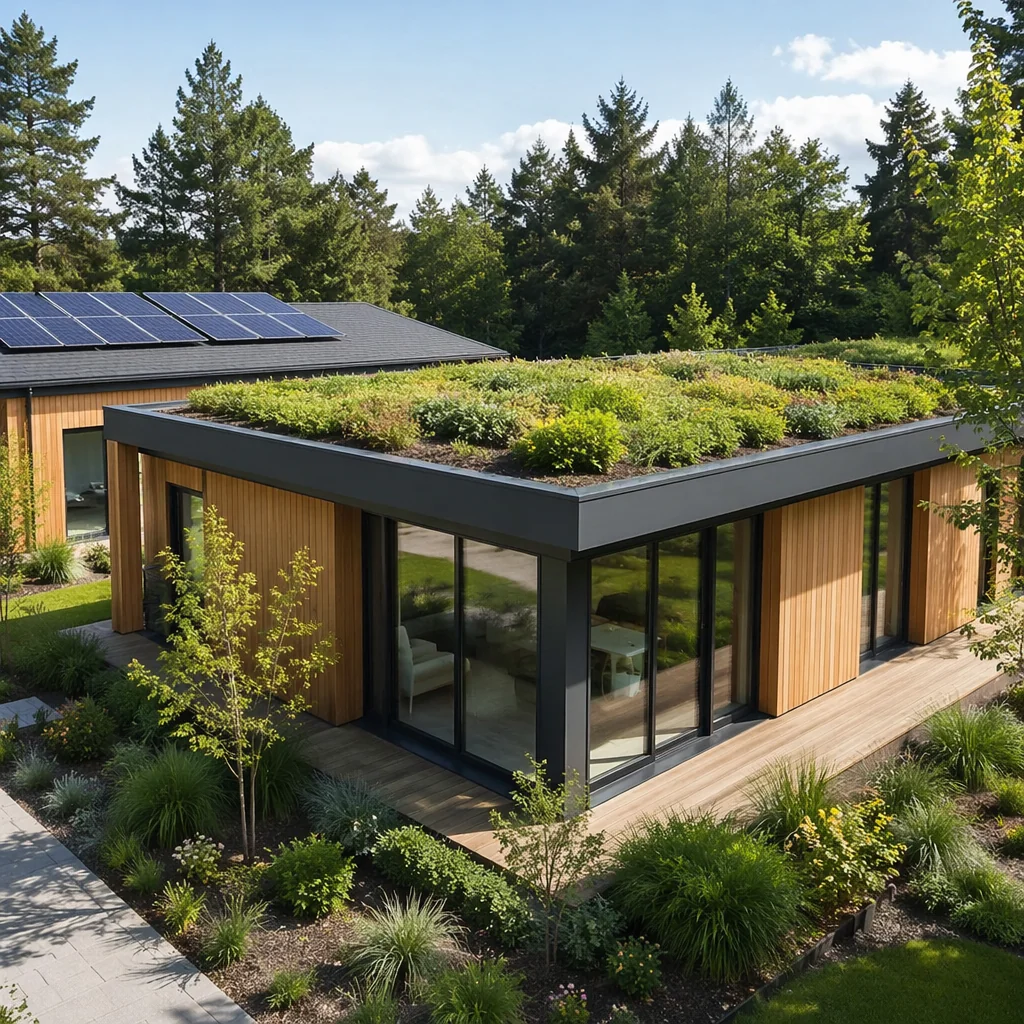
Waste Reduction: 70% Less Going to Landfill
On a traditional construction site, 15-20% of all materials delivered end up as waste. Drywall off-cuts, lumber scraps, damaged insulation, over-ordered materials — it all goes to landfill. The Construction & Demolition (C&D) sector generates over 600 million tons of waste annually in the US alone.
In our factory, waste is engineered out of the process:
- CNC cutting optimization: Software nests cutting patterns to minimize off-cuts, similar to how garment factories optimize fabric use
- Just-in-time material delivery: Materials arrive when needed, no weather damage from on-site storage
- Off-cut recycling: Steel, wood, and drywall off-cuts are sorted and recycled at the factory — not thrown in a dumpster
- Quality control eliminates rework: Defective work is caught at the workstation, not after installation
Our measured waste rate: under 3% of materials by weight. That's a 70% reduction compared to the industry average.
On a 100-unit apartment project, traditional construction sends approximately 120 tons of waste to landfill. Our modular process sends less than 35 tons — and 80% of that is recycled, not landfilled.
Embodied Carbon: 30% Lower Per Square Meter
Embodied carbon — the CO₂ emitted during material production, transport, and construction — is the construction industry's hidden climate impact. While operational energy efficiency gets most of the attention (solar panels, insulation, heat pumps), embodied carbon accounts for over half of a new building's 10-year carbon footprint.
How Modular Reduces Embodied Carbon
- Material efficiency: CNC-optimized cutting means less material purchased, transported, and wasted
- Fewer transport trips: Modules ship as finished units, replacing dozens of material delivery trips to a construction site
- Reduced on-site equipment: Less crane time, fewer generator hours, shorter site mobilization period
- Structural optimization: BIM engineering optimizes steel and concrete quantities to precise loads, not conservative estimates
Our lifecycle assessment (LCA) data shows modular buildings achieve 30% lower embodied carbon per square meter compared to equivalent traditional builds — before accounting for the operational energy savings.
Operational Energy: 25% Above Code
Modular buildings aren't just greener to build — they're greener to operate. The precision of factory construction creates tighter building envelopes with fewer air leaks and thermal bridges.
Why Factory-Built Envelopes Perform Better
- Air sealing: Factory-controlled conditions allow for meticulous air sealing — our modules test at 0.15 ACH50, well below the 0.40 ACH50 Passive House requirement
- Insulation consistency: No gaps, compression, or moisture damage from on-site installation in adverse weather
- Thermal bridge elimination: Precision-engineered connections between modules eliminate thermal bridges common in traditional construction
- Window installation: Factory-installed windows are sealed and tested under controlled conditions
The result: our standard modular buildings exceed International Energy Conservation Code (IECC) requirements by 25%. Optional net-zero-ready packages are available for projects targeting full carbon neutrality.
Designed for Disassembly: The Circular Building
Perhaps the most significant sustainability advantage of modular construction is one most people never think about: what happens at the end of the building's life?
Traditional buildings are demolished. The concrete is crushed, the steel is recycled (at significant energy cost), and everything else goes to landfill. A 50-year-old building produces as much waste in demolition as it did in construction.
Modular buildings are designed for disassembly. Our modules are connected with bolted connections, not welded or permanently bonded joints. This means:
- Relocation: An entire building can be disassembled, transported, and reassembled on a new site
- Repurposing: Individual modules can be removed and repurposed — an apartment module becomes a classroom, a hotel room becomes a remote office
- Component recovery: Steel frames, windows, doors, and fixtures can be recovered and reused at end of life
ESG Reporting and Certification
For developers and investors with ESG commitments, modular construction provides verifiable, quantifiable sustainability data that traditional construction cannot match:
- LEED Certification: Our buildings typically achieve LEED Silver to Platinum, with points available for construction waste management, regional materials, and design for flexibility
- BREEAM: Excellent rating achievable with our standard specifications
- WELL Building Standard: Factory-installed finishes use low-VOC materials, supporting indoor air quality credits
- Carbon accounting: Our LCA data provides per-project embodied and operational carbon figures for Scope 3 reporting
Real Data: 100-Unit Apartment Project LCA
Here's a lifecycle assessment comparison from a recent 100-unit apartment project, measured over a 50-year building lifespan:
- Embodied carbon: 1,850 tons CO₂e (modular) vs. 2,650 tons (traditional) — 30% reduction
- Construction waste: 35 tons (modular) vs. 120 tons (traditional) — 71% reduction
- Operational energy: 28% below IECC baseline (modular) vs. code minimum (traditional)
- Water usage during construction: 45% less (factory recycles process water)
- End-of-life recovery rate: 85% of materials recoverable (modular) vs. 30% (traditional demolition)
The Bigger Picture
The construction industry is at an inflection point. Developers, investors, and governments are increasingly demanding verifiable sustainability — not greenwashing, but measurable reductions in waste, carbon, and resource consumption.
Modular construction delivers this not through add-on features or premium materials, but through a fundamentally more efficient process. It's the difference between making a car by hand in a driveway and making it on a factory production line. The factory isn't just faster and cheaper — it's inherently less wasteful.
For ESG-focused developers, the choice is increasingly clear. The greenest building is the one that's built with the least waste, the lowest carbon, and the longest reusable life. That building is modular.
Want a project-specific environmental impact assessment? Contact our sustainability team for a free LCA analysis tailored to your project.